By Jamie Dean
As a first-year student at IIT, I’ve spent over a semester living in, commuting to and from, and going to and church in Bronzeville. However, the amount that I’ve actually seen or appreciated the neighborhood is surprisingly minimal. Last week, another classmate and I got a chance to really see and explore the neighborhood and its historical sites for the first time. Here’s what we found!

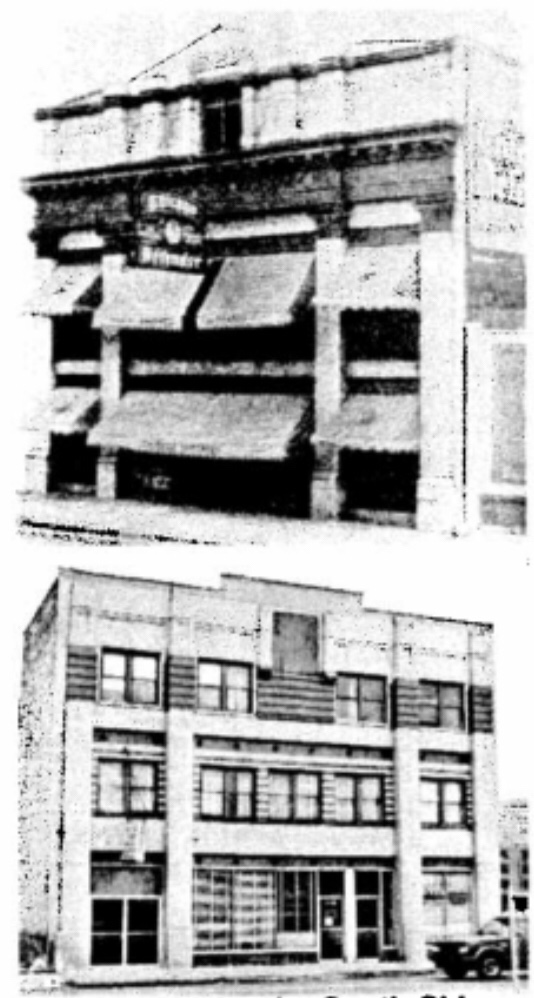
First, we went to see the Chicago Defender Building. This former synagogue was home to the Chicago Defender, a publication famously influential in advocating for civil rights issues in the mid 1900s. Founded by Robert Sengstacke Abbott in 1905, the Chicago Defender helped fuel the migration of so many African-Americans to the
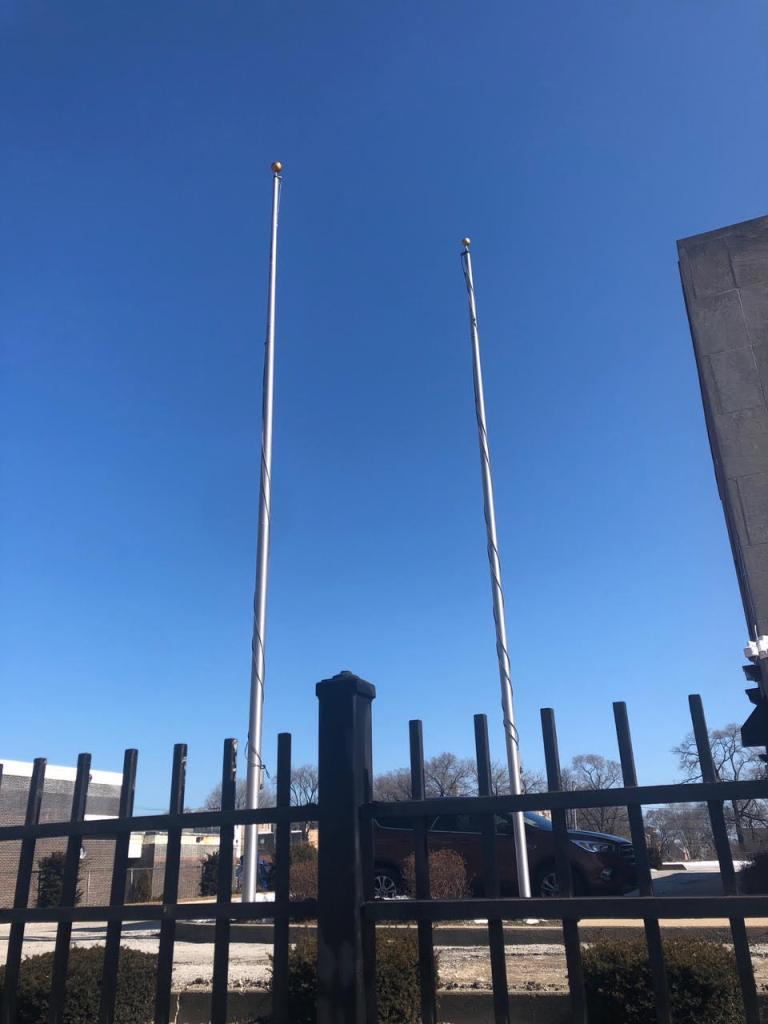
Bronzeville area. Now, it is a dedicated Chicago Landmark. However, we did not go to this landmark. Instead, we went to 4445 S King Drive and found ourselves at a newer building. I was initially a little confused as to what building it was, because it looked very different from the images in any article I’d read on the defender building. I later found, however, that the Chicago Defender, after moving downtown in 2005, moved back to its roots in Bronzeville. This was building we visited. The building is also home to the Samuel DeWitt Proctor Conference, and Blanc Gallery.

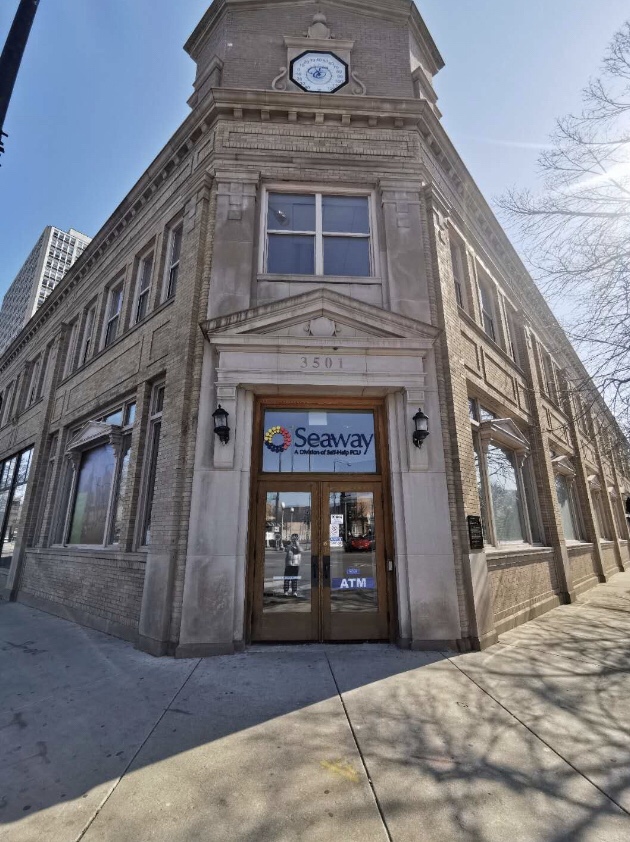
Next, we visited the Supreme Life Building, home of the Supreme Life Insurance Co. This Chicago Landmark is extremely significant because it was home to the first African-American owned and operated insurance company in the northern United States. At first, I wasn’t even sure this was the right building, as the entrance had a sign for Seaway Bank, making the building blend in with the surrounding modern city. Then we noticed the plaque on the side of the building, labeling it the Supreme Life Building. It was closed and we tried the doors, but they were locked. A keycard reader next to the door was the only way in.
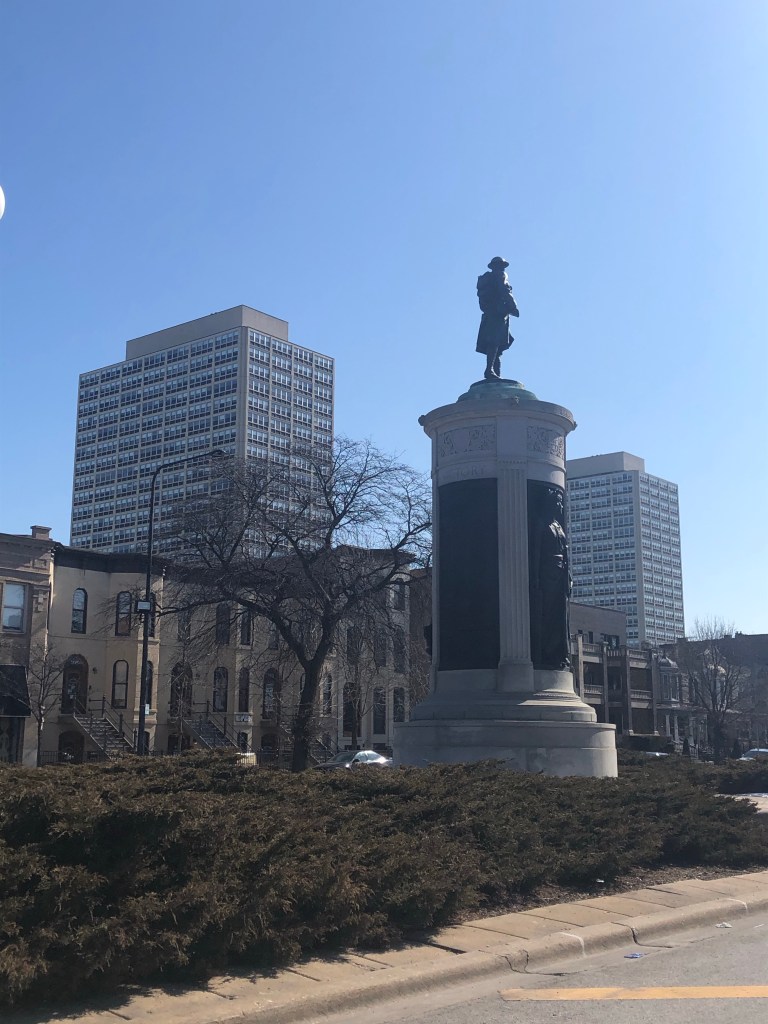
Not far from there were our next two destinations, the Victory Monument and the Bronze Map of Bronzeville. The Victory Monument depicts a huge statue of a soldier standing on a pillar. The pillar beautiful carvings on the sides and the monument itself represents “…an enduring tribute to American Black soldiers who served their country at the height of racial segregation in the military and in America” (Johnson). Knowing the meaning behind the monument made it seem all the more impressive to me as I looked up at it.

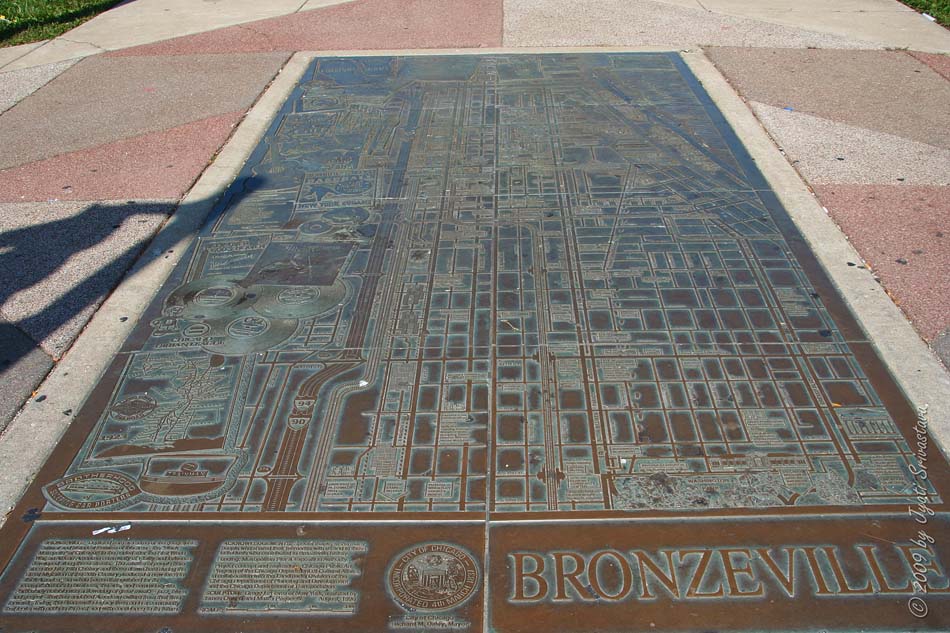
The Bronze Map of Bronzeville, though easy to miss, is a beautifully carved bronze map on the sidewalk median between the two sides of King Drive. The map not only showed the official building and street names, but it showed an insider’s view of the neighborhood from a cultural and historical context. Some of the places on the map were features on the map included important historical buildings and factors (like the Bee Building, the Chicago Defender, and the Quinn Chapel) in larger letters with pictures. While we observed the map, many people walked past, stepping over the map without noticing it, as I had always done before when passing by. Another sign showed a map of Chicagoland.
After this, we went along the Bronzeville Walk of Fame on King Drive between 26th and 35th street. This was probable the most exhilarating part of our entire exploration of Bronzeville because, for me, it was amazing to see all the people commemorated in the sidewalk and to go from plaque to plaque looking for more people. At first, we started on 26th street and ran down the street eagerly, hoping to see every single plaque. However, after what seemed like an endless amount of running and looking, we realized the walk of fame was much longer than anticipated. Out of breath and exhausted, we decided to rest and continue the rest of our field trip in another part of Bronzeville. Still, I made a pact with myself that I would go back sometime in the near future and finish looking at all of the plaques in the Bronzeville Walk of Fame.


Next, we saw the Great Migration Statue. At first, I wasn’t very appreciative of the way it looks. The statue is a 15-foot tall depiction of a traveler with a briefcase holding up his hand. His clothes resemble bird feathers, and he stands on a pile of these feathers. When I did some more research, though, I learned that the statue represents “…thousands of African-Americans that migrated to Chicago in the early 20th century in search of greater freedom and opportunity.” (Monument to the Great Migration) The feathers are like a bird migrating to a place of greater freedom. Knowing this made me think of the statue in a different way and develop more appreciation for it.

Quinn Chapel A.M.E. Church hours and service times 
Quinn Chapel Sign 
Martin Luther King Plaque 
View of Quinn Chapel from next to the empty lot. (It’s HUGE!) 
Quinn Chapel Chicago Landmark Plaque
Finally, we drove to Quinn Chapel and somehow managed to find parking nearby. When walking from where we parked to the church, we passed by a building called King Auto Body Repair Shop. Interestingly, the entire wall on the south side of the building was covered in vibrant street art of various designs, styles, and significance. Near this area, there was a lot of street art present. (At least more than in most other parts of the city). Captivated, we stopped to take some pictures before continuing to the church. When we got there, I immediately noticed that the building was huge and built with different, older-looking bricks than the other buildings in the area. This gave it an almost ancient feel. The church had a plaque on the wall labeling it as a Chicago Landmark. Another plaque nearby showed the face of Martin Luther King Jr. with quotes underneath, saying “I have seen the promised land”, and “We shall overcome.” Another sign showed the Church Service, Sunday School, and Bible Study times. Next to the church was an empty lot, the fence around it lined with barbed wire.


hink street art is part of what gives Bronzeville life and beauty.
I was overall amazed to see how beautifully Bronzeville showcases its rich history throughout the neighborhood. I was also shocked to realize that in all my time spent here, I’d never noticed the significance of many structures and monuments I walked past all the time. In all honesty, however, the historic buildings that we went to see were not what I expected. Many of them did not seem to showcase what they represent at first glance, and were barely even noticeable with the bustle of the surrounding city. But after slowing down and intentionally observing these places with knowledge of the neighborhood’s history, I was able to see so much more.
Sources:
Johnson, Erick. “The Victory Monument Gets Polished.” The Crusader Newspaper Group, 6 Sept. 2018, chicagocrusader.com/the-victory-monument-gets-polished/.
Jyoti. “Bronzeville Street Map.” Public Art in Chicago, 29 Sept. 2009, chicago-outdoor-sculptures.blogspot.com/2009/09/bronzeville-street-map.html.
The Black Metropolis-Bronzeville District: Preliminary Staff Summary of Information. Department of Planning and Development, Landmarks Division, 1997.
“Monument to the Great Migration.” Choose Chicago, http://www.choosechicago.com/listing/monument-to-the-great-migration/.
Stephanie, Daniels. “Bronzeville Residents Take A Stand Against Displacement.” Metropolitan Tenants Organization, 10 June 2019, http://www.tenants-rights.org/bronzeville-residents-take-a-stand-against-displacement/.
 Global Chicago